
Reviewed · JERUSALEM OLD CITY TOURS
Classic Jerusalem Old City Tour – Dguide Self Guiding App
Jerusalem’s Old City is best explored with time to stop, look up, and follow a side street when something catches your eye. This DGuide self-guided walk puts Uri Goldflam’s 30 years of experience in your phone, leading you from Jaffa Gate through major Jewish and Christian sites, Roman ruins, and the city’s oldest layers.
I like two things right away: the $7 price makes it an easy choice for budget travelers, and the flexible format lets you listen as much or as little as you want. The main drawback is just as clear: you will not have a live guide beside you to answer questions, manage the route, or explain what is happening when the Old City gets crowded.
Key points to know before you go

- Eight stops connect Jerusalem’s major sights, including Jaffa Gate, Mount Zion, the Western Wall, and the Church of the Holy Sepulchre.
- Uri Goldflam supplies the voice and content, drawing on three decades as a professional guide and educator.
- The route takes about two to four hours, depending on how long you spend at the museums and religious sites.
- The app lets you wander, then return to the suggested route instead of forcing you to follow a fixed path.
- Museum admission is extra, including the Tower of David Museum and the Wohl Archaeological Museum.
- Expect stairs and a fair amount of walking, so moderate physical fitness is required.
A low-cost way to get your bearings in the Old City
At $7 per person, this is priced more like a useful walking companion than a traditional guided tour. You get a route through some of Jerusalem’s most important places without paying for a private guide by the hour.
That matters in the Old City, where a short walk can cross centuries and several religious traditions. A phone-based guide gives you a starting point and some context, but you remain in control of the pace.
The tour normally takes two to four hours. The shorter end works if you keep moving and treat the museums as exterior stops. Allow more time if you enter the Tower of David Museum, pause at the Western Wall, or spend time inside the Church of the Holy Sepulchre.
The app is free to download, but access to this specific tour comes through a coupon code supplied after booking. Look for that code in the Before You Go section of your confirmation email. Without it, you may have the app but not the purchased route.
More of the Old City from Jerusalem:
- Jerusalem: Guided Walking Tour of the Old City
★ 4.7 · 386 reviews - Best seller! Jerusalem old city four quarters tour
★ 5.0 · 123 reviews - Private Tour Jerusalem Old City
★ 5.0 · 118 reviews
Starting at Jaffa Gate
Jaffa Gate is a practical starting point because it is one of the best-known entrances to Jerusalem’s Old City. The route gives you a brief orientation before leading you inside.
This first stop is short, about 10 minutes, but it serves an important purpose. The Old City can feel confusing at first, with narrow lanes, changing street levels, and signs pointing toward several important sites. A clear starting point helps you understand where the walk begins and what direction you are taking.
You should treat Jaffa Gate as a meeting and orientation point, not a major sightseeing stop by itself. The real value comes from using it to establish your bearings before the route moves toward the citadel and Mount Zion.
The Tower of David and a 360-degree city view
The Tower of David Museum occupies the ancient citadel near Jaffa Gate. It tells the story of Jerusalem through the fortifications and courtyards of the site itself, giving the opening part of the walk a strong connection between place and history.
Plan about an hour here if you enter. The museum admission is not included, so budget for an additional ticket. If you are trying to keep the outing close to $7, you can follow the app’s explanation from outside and continue, but you will miss one of the main paid stops.
One especially useful feature is the view over both the Old City and the newer parts of Jerusalem. Seeing the city from above helps you make sense of the walls, neighborhoods, and religious landmarks you will encounter on foot.
The citadel also carries Christian associations connected with the traditional location of Jesus’s trial. The wording matters here. This is a traditional identification, not a claim that the exact location has been proven. The app’s strength is that it can place those traditions alongside the physical remains without requiring you to join a formal group.
Mount Zion’s cluster of sacred places
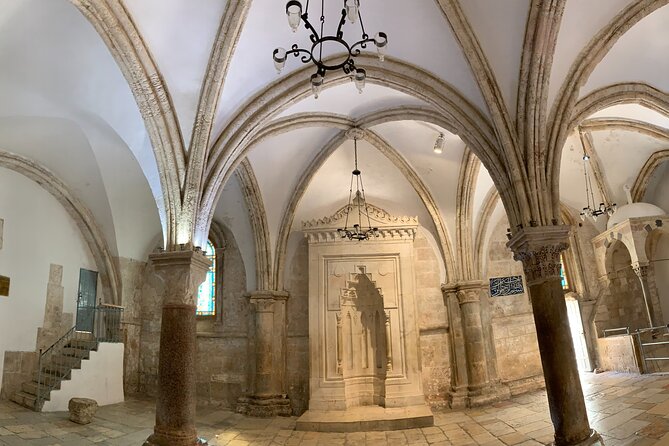
The route then reaches Mount Zion, where several important sites sit close together. The planned visit takes about 30 minutes and includes the Dormition Abbey, the Upper Room, and the traditional tomb of King David.
This section works well for anyone interested in the overlap between Jewish and Christian traditions. The Upper Room is traditionally associated with the Last Supper, while King David’s tomb is a traditional site of Jewish remembrance. The Dormition Abbey adds another major Christian landmark to the same stretch of the walk.
You should allow some flexibility here. Religious sites may require a quieter pace than ordinary sightseeing, and the experience can feel different depending on whether you are visiting for faith, history, architecture, or general interest. The app gives you the background, while you decide how long to remain.
The Old City route is not simply a march between famous names. Mount Zion shows why Jerusalem can be difficult to explain in a single story. Several traditions may point to the same place, and the guide’s job is to help you understand those layers without forcing you to hurry.
Same base, a different sort of day:
- From Jerusalem: Masada & Dead Sea Full Day Tour with Pick Up
★ 4.5 · 815 reviews - Masada and the Dead Sea Day Trip from Jerusalem
★ 4.5 · 757 reviews - From Jerusalem: Nazareth and Sea of Galilee Tour
★ 4.5 · 588 reviews - Nazareth and the Sea of Galilee Day Trip from Jerusalem
★ 4.5 · 446 reviews
The Roman Cardo and Jerusalem under Hadrian

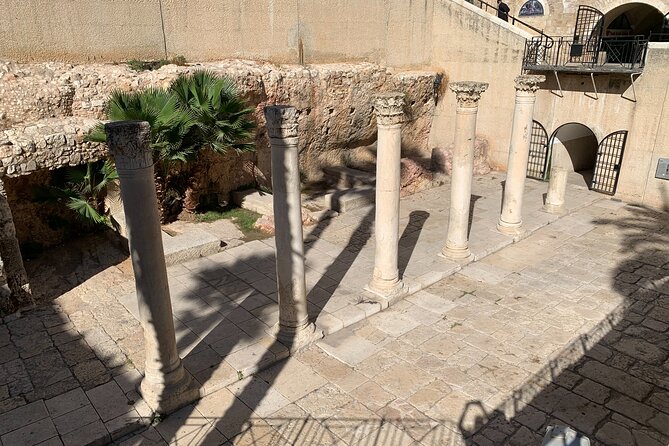
One station takes you to the Roman Cardo, the main colonnaded street associated with Jerusalem’s rebuilding under Emperor Hadrian in the first half of the second century.
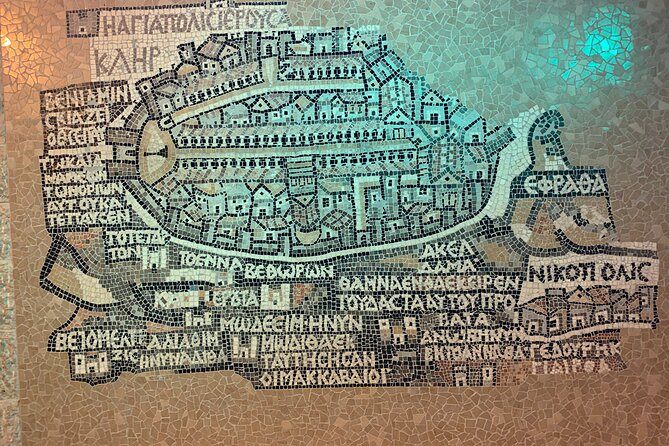
Here, you can walk along surviving Roman pavement and see a replica of the Medeba Map, an early map of Jerusalem. The map is especially helpful because it gives you a visual record of how the city was represented in late antiquity.
This is the sort of stop that can be easy to overlook if you are walking alone. You might see old stone and assume it is simply another ruin. With the route’s explanation, the pavement becomes evidence of a city rebuilt according to Roman planning after earlier destruction.
The Cardo also gives the walk a welcome change of focus. Instead of concentrating only on biblical and religious sites, it shows Jerusalem as a Roman city shaped by imperial decisions, construction projects, and political change.
A 2,700-year-old relic from the time of Hezekiah

Another station focuses on a relic mentioned in the Bible and linked with the time of King Hezekiah, about 2,700 years ago.
The supplied tour information does not identify the relic by name, so you should rely on the app for the precise explanation and location. What matters for planning is that the route moves beyond the familiar headline sights and points you toward an older layer of Jerusalem.
This is one of the better reasons to use a structured route instead of simply wandering. Without some direction, you could pass an important ancient feature without realizing what it represents. The app helps connect the object to the city’s biblical period and to the broader story of Jerusalem’s water, defenses, and survival.
First-century homes in the Herodian Quarter
The Herodian Quarter, also known as the Wohl Archaeological Museum, presents excavated homes from Jerusalem’s first century. You can see large residences, costly decoration, and signs of the destruction caused by the Romans in AD 70.
Allow about 30 minutes for this stop. Admission is not included, so check the extra cost before you go if you are watching your budget.
This museum is valuable because it moves the story away from rulers and monumental buildings and into domestic life. Large homes and expensive finishes show how wealthy families lived before the city was destroyed. The remains also make the events of AD 70 more concrete. Destruction is not just a date in a textbook when you can see what happened to homes and neighborhoods.
You may find this stop more rewarding if you enjoy archaeology. It is less about dramatic views and more about close attention to walls, rooms, decoration, and layers of construction. The app can provide the framework, but you will need to look carefully and give the site a little time.
The Western Wall, one of Jerusalem’s most powerful stops
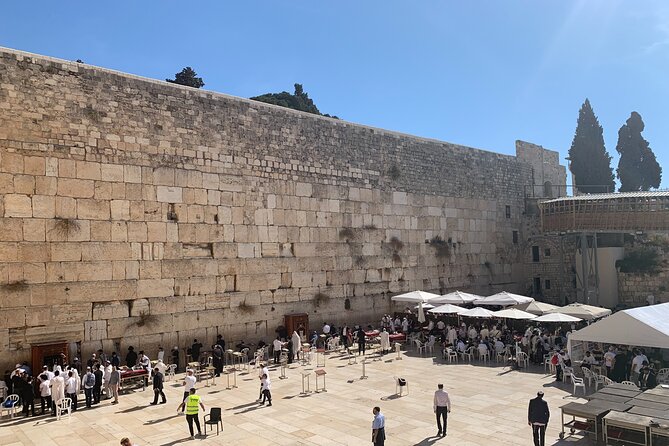
The Western Wall is a remnant of the Temple complex and the closest place to the Temple Mount where Jewish prayer takes place. The planned stop lasts about 20 minutes, and admission is free.
This is a place where you should be prepared to slow down and behave respectfully. It is an active place of prayer, not simply an archaeological attraction. Dress and conduct should suit a religious setting, and you should be ready for the atmosphere to differ from one part of the plaza to another.
The app can explain the wall’s significance, but no recording can replace the need to observe what is happening around you. Give people space, pay attention to signs, and treat the site as a living place of worship.
For many visitors, the Western Wall is the emotional center of the route. For others, the importance lies in its historical connection to the Temple. The self-guided format gives you the freedom to decide how long to stay without holding up a group.
The Church of the Holy Sepulchre
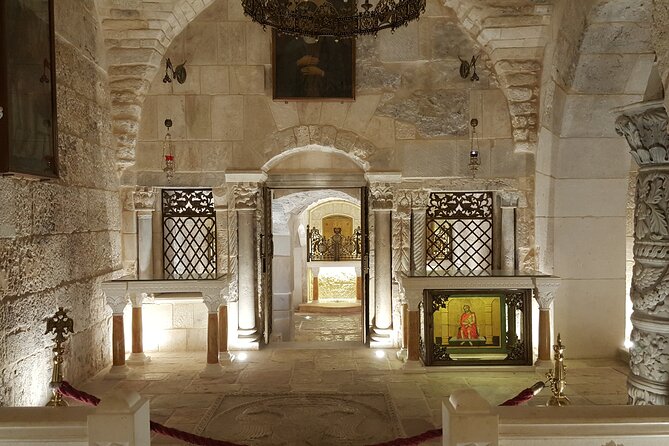
The final major stop is the Church of the Holy Sepulchre, on the traditional site of Jesus’s crucifixion and resurrection. The church was first built in the fourth century and has been reconstructed many times since.
The planned visit takes about 30 minutes, though the amount of time you need depends on your interest and the conditions inside. Admission is free.
This is one place where the route’s historical framing is particularly useful. The building is not a single untouched structure from the fourth century. It reflects construction, destruction, repair, and later rebuilding across many centuries.
You will encounter several Christian traditions within one complex. The app helps explain why the church matters and how its long development shaped the site you see today. You should still expect the visit to be active and religious rather than museum-like.
A self-guided visit also gives you room to pause quietly or move on if the setting feels too crowded. The tradeoff is that you will need to manage your own timing and find your way through the final part of the route.
How the self-guided format works
The DGuide platform is designed to let you follow a suggested path, leave it when you want, and return later. That is a real advantage in Jerusalem, where you may want to spend longer at one site or make an unplanned stop.
You can take in the information at your own pace. If a stop interests you, stay with it. If you already understand a subject or want to reach the next landmark, move on.
The experience is not a live tour led by Uri Goldflam in person. His role is in the route and recorded content, based on 30 years of guiding and teaching. That distinction is important if you are comparing this with a private walking tour.
The supplied activity information identifies this as a private activity for your group, but the actual experience is app-based rather than a face-to-face tour. In practical terms, you get privacy and flexibility, but not a person beside you to handle questions or changes in the route.
Walking, stairs, hours, and practical planning
The tour begins and ends at Jaffa Gate in Jerusalem’s Old City. It is near public transportation, which makes it easier to reach without arranging private parking. Parking fees are not included.
You need moderate physical fitness. The route requires walking and using stairs, so comfortable shoes are more important than dressing for a polished city outing. The Old City’s changing levels and stone surfaces can make a short distance feel slower than it looks on a map.
The stated operating hours are Monday through Thursday from 8:00 AM to 5:00 PM. Those hours are important because the museums and religious sites may not fit neatly into a late-day visit. Start early enough to allow for pauses and extra time at the paid museums.
The tour is usually booked about 35 days ahead, which suggests you should reserve early if your Jerusalem schedule is fixed. The booking confirmation arrives at once, and free cancellation is available until 24 hours before the start time. Changes or cancellations inside that 24-hour window are not accepted for a refund.
Who will get the most from this $7 route
I would recommend this experience to independent visitors who want a framework but dislike being tied to a group timetable. It also suits couples, families with older children, and small private groups who want to decide how long to spend at each place.
It is a strong choice if you already know you want to visit several major landmarks and want background information for a very small price. The route also works well as a first introduction to the Old City before returning later to explore favorite areas in more detail.
I would be more cautious if you need a live expert, have limited mobility, or want every admission and explanation handled for you. The walking and stairs are real considerations, and the two museums require separate admission.
Should you book the Classic Jerusalem Old City Tour?
Book it if you want a flexible route, strong historical context, and excellent value for a self-guided outing. At $7, it is an inexpensive way to connect the Old City’s Roman, Jewish, and Christian landmarks without committing to a long private tour.
Skip it if your priority is personal conversation with a guide. Uri Goldflam’s experience shapes the material, but the app cannot respond to your questions or adjust the tour around your interests.
For many independent visitors, the best approach is to use this as a well-priced orientation walk. Start at Jaffa Gate, follow the route through the major sites, pay separately for the museums that matter most to you, and leave enough time to stop when Jerusalem gives you a reason.
FAQ
How much does the Classic Jerusalem Old City Tour cost?
The tour costs $7 per person.
Is a live guide included?
No. This is a self-guided app experience. The content was created by Uri Goldflam, a professional guide and educator with 30 years of guiding experience.
What app do I need?
You need the free DGuide app. After booking, use the coupon code in the Before You Go section of your confirmation email to access this tour.
How long does the tour take?
The experience takes approximately two to four hours.
Where does the tour start?
The tour starts at Jaffa Gate in Jerusalem’s Old City.
Where does the tour end?
The activity ends back at the meeting point at Jaffa Gate.
Are museum tickets included?
No. Admission to the Tower of David Museum and the Herodian Quarter, also called the Wohl Archaeological Museum, is not included.
Are the Western Wall and Church of the Holy Sepulchre free to enter?
The listed tour information states that admission is free for the Western Wall and the Church of the Holy Sepulchre.
Does the route require much walking?
Yes. You should have moderate physical fitness because the tour requires walking and using stairs.
Can I cancel for a refund?
Yes. You can cancel up to 24 hours before the experience start time for a full refund. Cancellations and changes made less than 24 hours before the start time are not accepted.
More Self-Guided Tours in Jerusalem
- In The Footsteps of Jesus Day Tour – Dguide Self Guiding App
★ 4.5 · 3 reviews - From Tel Aviv: Dead Sea Self-Guided Chill-Out Day Trip
★ 4.2 · 64 reviews
Just added in Jerusalem
- jerusalem classic tour★ 5.0 · 3 reviews
- kosher Israel wine tour★ 5.0 · 4 reviews
- Tour of Jerusalem & Dead sea private tour★ 5.0 · 4 reviews
- West Bank Tour from Jerusalem and Tel-Aviv – Bethlehem & Jericho★ 5.0 · 6 reviews
- full day tour Jerusalem price per van up to 6 people★ 5.0 · 8 reviews
- Tour of Masada-Dead Sea and Qumran from Jerusalem★ 3.5 · 11 reviews
- Full Day Private Christian Tour in Jerusalem with Tour Guide★ 5.0 · 28 reviews
- Magical Walking Tour in Old City of Jerusalem★ 5.0 · 27 reviews
Jerusalem Old City Tours, compared.






Jerusalem Half Day Tour: Holy Sepulchre and Western Wall
Read our review →

City of David and Underground Jerusalem Day Tour
Read our review →Browse the lists this tour appears in